
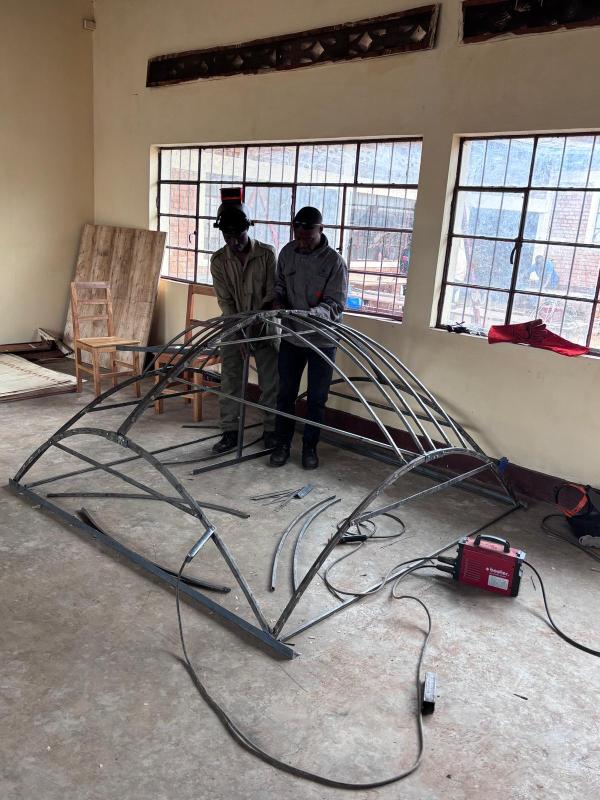
V2SDF training advances as educators use assembly jigs to construct the precise skeleton of the new Prince 23 model.
Precision in sustainable technology manufacturing is not achieved by chance, but through methodical processes and specialized tools. Following the careful bending of components, the V2SDF project training has entered a critical phase that ensures geometric accuracy and repeatability.
From July 7th to 25th, 2025, the pilot workshops at LTCR Mushasha became a laboratory of precision assembly. Educators from CEM Gitaba, CEFORE Rusi, and LTCR Mushasha progressed to the next vital stage in building the Prince 23 parabolic solar cooker: the assembly of the curved bars onto the structural jig (gabarit).
This phase moves from creating individual parts to forming a unified, accurate structure. Participants meticulously positioned each pre-bent steel bar into the dedicated assembly jig—a custom template or frame that holds all components in their exact correct alignment. This tool is essential for guaranteeing that the parabolic shape of the cooker is perfect before any permanent welding or fastening begins.
Why the Jig Assembly is a Keystone Process:
Ensuring Geometric Fidelity: The jig eliminates guesswork and human error, ensuring every Prince 23 frame produced will have the identical, optimal curvature required for efficient solar concentration.
Foundation for Scalability: Mastering jig-based assembly is key to scalable, consistent, and quality-controlled local production. It transforms custom craftsmanship into repeatable manufacturing.
Skill in Precision Alignment: This task hones the educators' ability to work to exact tolerances and understand how a final product is built from a series of carefully aligned sub-assemblies.
In the workshop, the sight of the curved bars slotting into the jig, gradually revealing the complete parabolic skeleton, marked a significant milestone. It demonstrated the tangible progress from raw materials to a recognizable product frame, built with industrial precision.
By mastering this assembly technique, the participating teachers are not just learning to build a cooker; they are learning to build it correctly, consistently, and efficiently. This knowledge is a powerful tool they will pass on, enabling future technicians in Burundi to produce reliable, high-performance clean cooking technology.
The V2SDF project continues to build a framework for sustainability—both literally, with the Prince 23 structure, and figuratively, through rigorous vocational education.
#V2SDF #VetToStopDeforestation #SolarCooker #Prince23 #Assembly #Jig #PrecisionManufacturing #VocationalTraining #CapacityBuilding #Burundi #RenewableEnergy #CleanCooking #SustainableEngineering #QualityControl